
.jpg)
Case Series/Study
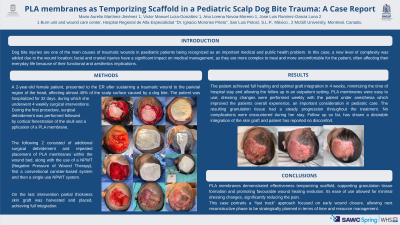
In this case report, we present a 2-year-old female patient who presented to the ER after sustaining a traumatic wound to the parietal region of the head, affecting almost 40% of the scalp surface caused by a dog bite. The patient was hospitalized for 32 days, during which she underwent 4 weekly surgical interventions.
During the first procedure, surgical debridement was performed followed by cortical fenestration of the skull and application of a PLA membrane. The following 2 consisted of additional surgical debridement and repeated placement of PLA membranes within the wound bed, along with the use of a NPWT (Negative Pressure of Wound Therapy), first a conventional canister-based system and then a single use NPWT system.
On the last intervention partial thickness skin graft was harvested and placed, achieving full integration.
PLA membranes demonstrated effectiveness temporizing scaffold, supporting granulation tissue formation and promoting favourable wound healing evolution. Its ease of use allowed for minimal dressing changes, significantly reducing the pain.
This case portraits a “fast track” approach focused on early wound closure, allowing next reconstructive phase to be strategically planned in terms of time and resource management.