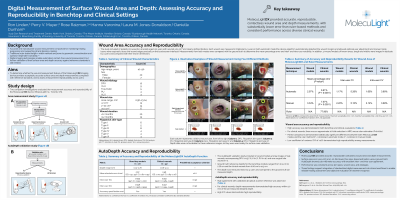
(CR-035) Digital Measurement of Surface Wound Area and Depth: Assessing Accuracy and Reproducibility in Benchtop and Clinical Settings
Friday, April 10, 2026
Perry Mayer, MB, BCh, FFPM RCPS (Glasg) – Medical Director, The Mayer Institute for Advanced Diabetic; Rose Raizman, RN-EC, PHCNP, NSWOC, WOCC (C), MSc, MScN; Hanna Varonina, MSc, CCRP – Clinical Trials Manager, MolecuLight Inc.; Laura Jones-Donaldson, PhD – Director of Clinical Trials & Education, MolecuLight Inc.; Danielle Dunham, MHSc – Director of Marketing and Product Management, MolecuLight Inc.
Introduction: Accurate and reproducible wound measurement is important for assessing healing progression and guiding clinical management decisions. However, traditional ruler-based measurement techniques are inherently unreliable, yielding inconsistent results across practitioners and settings due to their susceptibility to geometric overestimation and operator-dependent variability as well as lack of standardization [1, 2]. The introduction of portable digital imaging systems has enabled automated, contact-free wound measurement, offering a transformative solution for improving precision and reproducibility at the point of care. This study assessed the accuracy and reproducibility of a handheld imaging device* designed to measure wound surface area, length, width, and depth compared with ruler-based measurements and ground truth digital photography methods.
Methods: This multicenter, prospective clinical study compared wound area measurements obtained with the imaging device* and ruler-based techniques against a ground truth digital photography method. Separate bench and clinical validations evaluated depth measurement performance using the device’s* AutoDepth function against a calibrated three-dimensional optical scanner. Accuracy, intra- and inter-user variability, and agreement were assessed using mean percentage error (MPE), coefficient of variation (CV), intraclass correlation coefficients (ICC), and Bland–Altman analysis.
Results: The device* demonstrated high accuracy and reproducibility for wound surface area, length and width measurements compared with ruler-based and ground truth digital photography methods and for depth compared with three-dimensional imaging. MPE for surface area was < 10%, representing a tenfold improvement over ruler estimation (77.9%). For wound area, intra- and inter-user CVs were < 10%, and for depth, ICCs were ≈0.99. Variability between users was minimal, and measurements showed consistency across a range of wound types, sizes, and skin types.
Discussion: The findings from this study demonstrated that the imaging device* delivered precise, consistent and reproducible measurements of wound area and depth across a range of wound types, exceeding the performance of conventional ruler-based methods, which are highly unreliable and inaccurate, when compared with ground truth methods. These findings suggest that integrating the device* into routine wound-assessment workflows can help overcome common limitations of conventional methods such as overestimation, variability, and inaccuracy, while allowing for more accurate monitoring and documentation of wound progression, and guiding more informed therapeutic decisions.

.jpg)