(CR-001) Effects of Glucagon-Like Peptide-1 (GLP-1) Agonists on Surgical Wound Healing: A Single Institution Study
Friday, April 10, 2026
Dominika Pullmann, MD; Hannah Belostotsky, BA Candidate; Tamara Mestvirishvili, MS; Ernest Chiu, MD; Cheongeun Oh, PhD; Piul Rabbani, PhD
Introduction: Glucagon-like peptide-1 (GLP-1) receptor agonists are increasingly prescribed for type 2 diabetes, obesity, and other rapidly expanding indications. Despite their widespread use, little is known about their effects on surgical wound healing. This question is especially relevant in high-risk groups, such as patients with diabetes, where impaired healing often complicates recovery.
Methods: We conducted a retrospective cohort study of 144 patient charts at the Department of Plastic Surgery at NYU Langone Health. From this cohort, 49 adult patients with 51 non-healing surgical wounds were identified. We stratified patients into seven medication regimen groups, including GLP-1 receptor agonists alone or in combination with insulin and/or metformin. Outcomes compared between GLP-1 users and non-users included time to wound closure, number of surgeries required for wound resolution, and categorical healing status. Time to wound closure was analyzed using Mann-Whitney tests and proportions using Fisher’s exact test, with p< 0.05 considered significant.
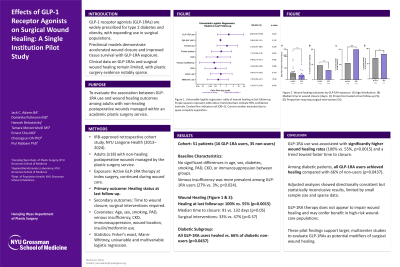
Results: Median time to closure did not differ significantly between GLP-1 users (n=15; median=91 days; 95% CI, 71-131) and non-users (n=27, median=132 days; 95% CI, 102-178; p=0.05). However, GLP-1 users demonstrated higher healing rates at follow-up (100% vs. 55%, p=0.0015) and required fewer surgical interventions (33% vs. 47%, p=0.37). Among patients with diabetes, 100% of wounds healed in GLP-1 users vs. 66% in non-users(p=0.0437). These trends were consistent across wound types and patient characteristics, suggesting a potential protective effect of GLP-1 receptor agonists.
Discussion: Although GLP-1 receptor agonists did not shorten time to closure, they were associated with higher healing rates and fewer interventions, particularly among diabetic patients. These findings suggest a possible role for GLP-1 therapy in modifying surgical wound healing.

.jpg)