(CR-046) Lactate-Mediated Healing in Burns: Mechanistic Insights Into the Bioactivity of PLA-Based Membranes
Friday, April 10, 2026
Ana Novoa-Moreno, MD – Burn Unit of the Hospital Regional de Alta Especialidad "Ignacio Morones Prieto", San Luis Potosi, SLP, Mx; Mario Martinez-Jimenez, PhD – Burn Unit of the Hospital Regional de Alta Especialidad "Ignacio Morones Prieto", San Luis Potosi, SLP, Mx
Introduction: Lactate has been studied for several years demonstrating a high potential in enhancing the healing process. Various theories have been discussed to explain this effect in wound healing. The objective of this work is to explore the mechanistic basis for the observed clinical efficacy of polylactic acid (PLA)-based membranes in burn wound healing, with emphasis on the role of lactate as a bioactive molecule.
Methods: This mechanistic review synthesizes experimental, translational, and clinical evidence regarding the effects of lactate released from PLA-based epidermal membranes in burn injury patients. Peer-reviewed data was compiled from cellular, animal, and human studies addressing vascular, immune, and neurosensory responses to lactate signalling in the wound environment.
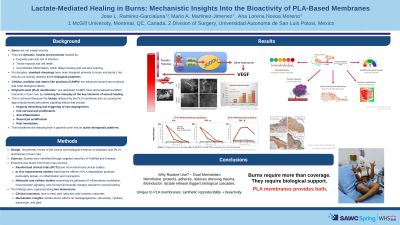
Results: Lactate released from PLA-based membranes initiates a multifaceted cascade of bioactive effects essential for burn repair. First, lactate mimics hypoxic signalling and activates hypoxia-inducible factor-1α (HIF-1α), promoting neoangiogenesis via VEGF expression. Second, fibroblast survival, keratinocyte proliferation, and extracellular matrix deposition are enhanced. Third, lactate modulates inflammation by shifting macrophage polarization from pro-inflammatory (M1) to reparative (M2) phenotypes. Fourth, it lowers wound pH, creating an acidic microenvironment that impairs bacterial growth and favours enzymatic activity involved in healing. Lastly, lactate reduces nociceptor sensitization through TRPV1 channel desensitization, contributing to adequate pain control. Clinically, these mechanisms correlate with faster healing, lower infection rates, reduced need for grafting, and improved patient comfort.
Discussion: PLA-based membranes act not only as physical wound coverings but also as bio-inductive platforms that release lactate, driving a cascade of regenerative effects. Their multifactorial action makes them uniquely suited for managing partial-thickness burns, with implications for broader use in complex wound care. Further clinical trials should continue to elucidate the optimal indications and comparative advantages of lactate-releasing dressings.

.jpg)