
.jpg)
Laboratory Research
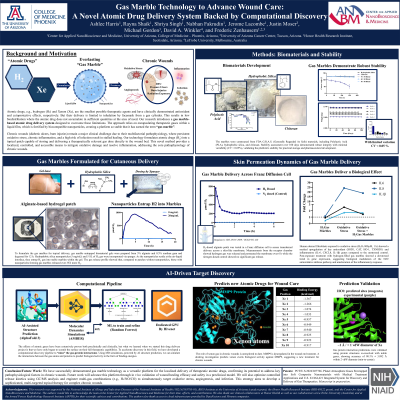
Effective wound healing remains a global challenge, where chronic, nonhealing wounds persist due to oxidative stress, inflammation, and insufficient angiogenesis. Current strategies often fail to address these overlapping deficits, underscoring the need for innovative therapies1. As atomic drugs (H2, Xe) are investigated as potent therapeutic molecules, molecular hydrogen has demonstrated selective antioxidant (Nrf2, SOD, MDA, CAT) and anti-inflammatory (IL-6/10/1β, I-CAM, TNFα) properties2,3. However, its therapeutic delivery has been largely limited to inhalation, resulting in non-targeted biodistribution.
Herein, we introduce a novel gas marble delivery technology, where therapeutic gas is entrapped within a nanoparticle-fortified liquid film, forming stable structures capable of withstanding up to 10× the Laplace pressure. For transdermal delivery to chronic wounds, these “marbles” are formulated into a topical patch. In parallel, this study utilizes a computational pipeline to investigate the interactions of gases with proteins dysregulated in the wound environment to discover new therapeutic capabilities of atomic drugs.
Methods: Biomaterials: Gas marble-entrapped biomaterial gels were formed from 5% alginate/0.5% xanthan gum. Hydrophobic silica nanoparticles (10mg/mL; 14nm diameter) and surfactant (Tween-20 0.1%) were incorporated, followed by sparging with H₂ gas (5sl/m, 25 μm pores, 5min.) and crosslinked with CaCl2 (1%). Hydrogen concentration was measured by Unisense microsensor.
Computational modeling: Protein structures were obtained from RCSB PDB. Non-standard residues and water molecules were removed, hydrogens added, and Gasteiger charges assigned. AutoGrid4 computed Xenon-protein interaction energy maps, and sites with binding energies < 0 kcal/mol were extracted.
Results:
Gas marble–entrapped biomaterials exhibited a cumulative H₂ release (AUC) of ~3,573 µmol-h over 24 h. Franz cell diffusion studies demonstrated ~21.31 μmol-h release (0–6 h vs. 0.0 mM N2-filled control), implying transdermal compatibility. Fibroblasts treated with H₂-filled marbles under oxidative stress showed a downregulation trend in Nrf-2 pathway genes (SOD1, CAT, HO-1, TXNRD1) and inflammatory markers (IL-6, IL-8, IL-β1), indicative of mitigation of oxidative stress-induced cellular damage. Binding energy calculations predicted Xe interacts with MMP9 (-1.367 - -0.917 kcal/mol), suggesting biological modulation.
Discussion:
Gas marble technology demonstrated potential as a targeted delivery system for chronic wound management. Computationally, the favorable interactions of Xe suggest a new application for Xenon in modulating tissue repair activity.