(CR-047) Modulation of pain in burn injuries through lactate-mediated mechanisms: a mechanistic revew of polylactic acid membranes clinical and biological impact.
Friday, April 10, 2026
Ana Novoa-Moreno, MD – Burn Unit of the Hospital Regional de Alta Especialidad "Ignacio Morones Prieto", San Luis Potosi, SLP, Mx; Mario Martinez-Jimenez, PhD
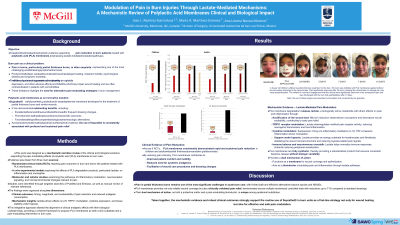
Introduction: Pain management is one of the most crucial aspects to consider when treating patients, particularly in burn care, as effective pain control is vital to ensure patient comfort and overall well-being. Pain can have significant physical, emotional, and psychological consequences that may interfere with daily activities such as eating and communicating, affecting mood and behavior, and having a profound impact on the family as well. In clinical practice, pain represents one of the most common obstacles physicians encounter, as inadequate control may limit proper wound assessment, treatment, and rehabilitation. Psychological distress experienced by the patient can persist long after the physical wounds have healed, affecting their quality of life and rehabilitation process. Polylactic acid membranes have demonstratedsignificant decrease of pain since first application in several comparative studies with other scaffolds.
Methods: This mechanistic review integrates data from randomized clinical trials (RCTs), in vivo models, and molecular studies assessing the biological effects of PLA membranes in burn care. Particular focus was placed on its influence on inflammatory modulation, neuroreceptorsignalling, and the wound microenvironment.
Results: In RCTs, PLA membranes have consistently demonstrated rapid and sustained analgesia in partial-thickness burns and donor site wounds, with pain reduction observed as early as the first dressing application. Mechanistically, its degradation product—lactate—exerts modulatory effects through several pathways: (1) acidification of the wound bed, potentially desensitizing nociceptors; (2) modulation of TRPV1 receptor activity, decreasing neurogenic transmission and inflammation; (3) downregulation of pro-inflammatory cytokines, such as IL-1β and TNF-α; and (4) support of cell survival under hypoxia, indirectly stabilizing the healing niche. These combined effects contribute to a less inflamed, less painful wound microenvironment.Compelling mechanistic evidence supports the clinical analgesic effects of PLA membranes. Lactate, traditionally seen as a metabolic byproduct, plays a bioactive role in reducing nociception and inflammation. These findings support the routine use of PLA membranes not only as a skin substitute but also as a pain-modulating intervention in burns.
Discussion: Compelling mechanistic evidence supports the clinical analgesic effects of PLA membranes. Lactate, traditionally seen as a metabolic byproduct, plays a bioactive role in reducing nociception and inflammation. These findings support the routine use of PLA membranes not only as a skin substitute but also as a pain-modulating intervention in burns.

.jpg)