
.jpg)
Practice Innovations
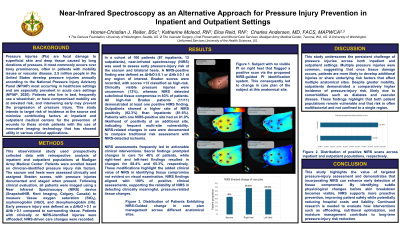
Pressure injuries (PIs) remain a major source of morbidity and healthcare cost, particularly among patients with limited mobility. Despite preventive strategies, early-stage PIs are often missed during clinical assessment. This study evaluated the utility of Near-Infrared Spectroscopy (NIRS) imaging as a tool for early PI detection in inpatient and outpatient settings.
Methods:
A prospective observational study with retrospective analysis was conducted at a tertiary care center, enrolling 100 patients (87 inpatients, 13 outpatients) at risk for PIs based on Braden scores and clinical risk factors. Primary anatomical sites assessed were the sacrum and bilateral heels. Following standard clinical evaluation, NIRS imaging (SnapshotNIR, Kent Imaging, Calgary, Canada) was performed to measure tissue oxygen saturation and hemoglobin levels. The difference in HbO (oxyhemoglobin) or Hb (deoxyhemoglobin) of >0.1 compared to the surrounding tissue was considered indicative of early pressure injury. Changes in care plans based on NIRS findings were documented.
Results:
NIRS detected evidence of pressure-related tissue compromise in 83% of patients, compared to limited findings on clinical exam. Outpatients demonstrated a higher relative incidence of NIRS-positive scans for PIs (92.3%) than inpatients (81.6%). All patients with Braden scores < 13 (11% of the cohort) exhibited positive NIRS findings. Patients with a positive finding at one site had an 81.9% likelihood of additional positive findings elsewhere. NIRS findings prompted changes in care plans in 46% of sacral assessments, 68.4% of right-heel assessments, and 65.3% of left-heel assessments. NIRS findings concurred with 100% of positive clinical assessments.
Discussion:
NIRS imaging provided actionable physiological data that enhanced early detection of pressure injuries and influenced clinical decision-making. Its use as a supplementary tool may improve PI prevention strategies, reduce patient morbidity, and decrease healthcare costs. Further longitudinal research is warranted to assess long-term outcomes of interventions guided by NIRS.
Disclosure: “Generative AI or AI-assisted technology was used in the preparation of this work. All AI-generated content was reviewed and edited by the author(s), who accept full responsibility for its accuracy and integrity.” AI was ONLY used for text drafting to ensure better readability.