
.jpg)
Case Series/Study
Conditions such as Diabetic Foot Ulcers can be difficult to achieve long-term healing in due to neuropathy leading to re-injury and frequently comorbid atherosclerosis causing reduced blood flow. Not all acid preparations are made equal, and in clinical trials Hypochlorous Acid* showed superior disinfectant properties compared to generic preparations. Thus, their product has been used in patients at the clinic whose wounds were determined clinically to potentially benefit from this therapy.
Our objective was to assess the antimicrobial and resurfacing efficacy of the Hypochlorous Acid* Spray by observing the healing process in a patient with a refractory wound previously unsuccessfully treated with the current standard of care wound treatments. This patient's Diabetic Foot Ulcer was refractory to standard of care wound treatments and achieved significant positive response to Hypochlorous Acid* therapy.
Methods: The patient was determined clinically by the physician to stand to benefit from hypochlorous acid therapy. They were provided informed consent in the clinic and completed weekly follow-up appointments in the clinic where their wounds were measured by wound care nurses and any changes in their treatment regimen were documented by the physician.
Results: The reduction from 13.32 cm^3 to 6.9 cm^2 surpasses the goal of wound care therapy of more than a 50% reduction in size of the wound, with further healing expected contingent on continued adherence to treatment regimen.
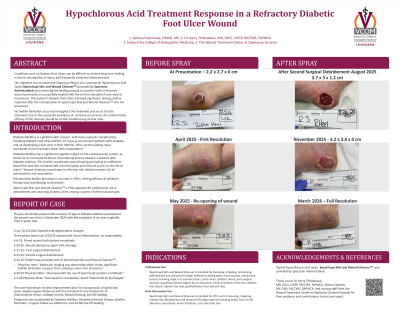
Discussion: Our patient presented to the clinic December 9, 2024 for a diabetic foot ulcer on the right heel and a sacrum burn injury. The patient followed up every 1-3 weeks with minimal improvement and underwent two surgical debridements in July 2025 and August 2025 due to granuloma tissue and biofilm formation likely contributing to chronicity. The patient was provided Mesalt packing material and Hypochlorous Acid* spray in September 2025 and provided instructions for her home health nurse. After the second surgical debridement in August 2025 her ulcer measured 3 x 3.7 x 1.2 cm and in December 2025 measured 2.3 x 3.0 x 0 cm with healthy granulation tissue and no peri-wound complications in between.