
.jpg)
Practice Innovations
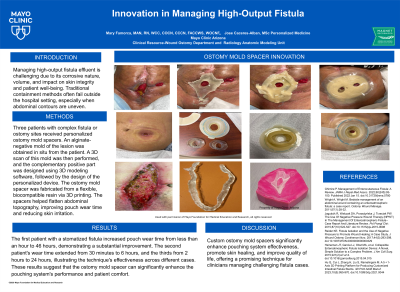
Managing high-output fistula effluent is challenging due to its corrosive nature, volume, and impact on skin integrity and patient well-being. Traditional containment methods often fail outside the hospital setting, especially when abdominal contours are uneven.
Methods:
Three patients with complex fistula or ostomy sites received personalized ostomy mold spacers. An alginate-negative mold of the lesion was obtained in situ from the patient. A 3D scan of this mold was then performed, and the complementary positive part was designed using 3D modeling software, followed by the design of the personalized device. The ostomy mold spacer was fabricated from a flexible, biocompatible resin via 3D printing. The spacers helped flatten abdominal topography, improving pouch wear time and reducing skin irritation.
Results:
The first patient with a stomatized fistula increased pouch wear time from less than an hour to 46 hours, demonstrating a substantial improvement. The second patient's wear time extended from 30 minutes to 6 hours, and the third's from 2 hours to 24 hours, illustrating the technique's effectiveness across different cases. These results suggest that the ostomy mold spacer can significantly enhance the pouching system's performance and patient comfort.
Discussion:
Custom ostomy mold spacers significantly enhance pouching system effectiveness, promote skin healing, and improve quality of life, offering a promising technique for clinicians managing challenging fistula cases.