(CR-037) Use of a Novel Hydrosurgical Debridement Device with Negative Pressure as a New Chronic Wound Therapy Model
Friday, April 10, 2026
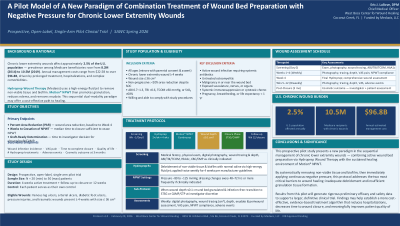
Introduction: This prospective, single-arm pilot study (N=20) aims to evaluate the combined efficacy of Hydrosurgical Wound Therapy and continuous Negative Pressure Wound Therapy (NPWT) in chronic, non-progressive lower extremity wounds. The primary objectives are to determine the Percent Area Reduction (PAR) at Week 4 and the median time required to cease NPWT application.
Methods: Twenty patients with chronic lower extremity wounds (< 36 cm2) non-responsive to standard care (4+ weeks) were enrolled in this 4-week protocol. Patients receive Hydrosurgical Wound Therapy (MWT) twice weekly for precise debridement and stimulation. NPWT is continuously applied between MWT sessions, with dressing changes every 48–72 hours. Follow-up is conducted until 100% wound closure or 12 weeks
Results: The combined therapy is projected to demonstrate high efficacy due to selective debridement and continuous stimulation. The data set shows Median Percent Area Reduction (PAR) of 78% at Week 4. The median time to cease NPWT (depth 0.1 cm) is 3.5 weeks, accelerating the transition to definitive closure. Low incidence of infection and measurable improvements in patient pain (VAS) and Quality of Life (QoL) scores are also expected.
Discussion: The combination of hydrosurgical Hydrosurgical Wound Therapy and continuous NPWT is projected to be a safe, rapid, and highly effective treatment pathway for chronic, stagnant lower extremity wounds. This data supports the adoption of this combined modality as an intensified treatment protocol for improved wound bed preparation and accelerated granulation, offering a potentially more cost-effective strategy for complex, non-healing wounds compared to prolonged standard care.

.jpg)