(CR-036) Retrospective Review of 5318 Patients with Chronic Lower Extremity Wounds Treated with Intermittent Topical Oxygen Therapy
Friday, April 10, 2026
Andrew Boulton, MD, DSc (Hon), FACP, FICP, FRCP; Anil Hingorani, MD; Palma Shaw, MD, FACS, RPVI; Vincent Rowe, MD, FACS; Lee Rogers, DPM; Anahita Dua, MD, MS, MBA, FACS
Introduction: This study evaluated the effectiveness of a unique multi-modality combination therapy that delivers noncontact cyclical compression with pressurized topical oxygen, intermittent topical oxygen therapy (ITOT), in the treatment of recalcitrant chronic lower extremity wounds of varied etiologies in a complex, comorbid population
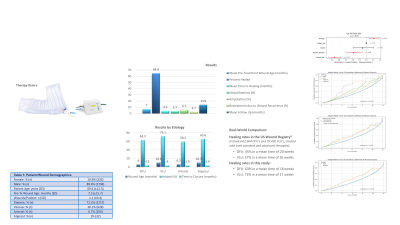
Methods: Data from 5318 patients treated between January 2023 and December 2024 for lower extremity wounds were retrospectively analyzed. Patients with incomplete data, or who were still receiving therapy and did not have outcome data were excluded, resulting in a final cohort of 3126 patients, 89.4% (n=2794) male and 10.6% (n=332) female. Chronic wounds treated included diabetic foot ulcers (72.2%, n=2257), venous leg ulcers (20.1%, n=628), arterial ulcers (7%, n=209), and atypical wounds (1%, n=32). The outcomes assessed included healing rates, retreatment rates, and complications. The mean patient age was 69.6 (±12.3) years. The mean pre-treatment wound age was 7.3 (±15.7) months, and the mean number of wounds per patient was 1.1 (±0.4).
Results: 64.8% (n=2027) of the wounds achieved complete healing in 4.2 (SD±2.5) months, despite a mean pre-treatment wound age of 7 (±15.9) months. The need for retreatment due to wound recurrence was low, 2.7% (n=54), with a mean follow up time of 13.9(±4.9) months. The rates of hospitalization and amputation were 3.7% (n=115) and 6.1% (n=191) respectively, with subgroup analyses showing consistent healing rates. ITOT therapy significantly reduced amputation and hospitalization rates compared to historical standards.
Discussion: Multi-modality ITOT is an effective, noninvasive, patient-applied therapy that synergistically addresses the root causes of chronicity seen in nonhealing wounds: inflammation, edema, and tissue hypoxia. In this large cohort study, ITOT demonstrated superior wound healing outcomes in complex, comorbid populations, compared to those reported in population based real world studies. The results of this study support the durable healing outcomes demonstrated in previously published ITOT randomized controlled trial and real-world evidence studies.

.jpg)