
.jpg)
Laboratory Research
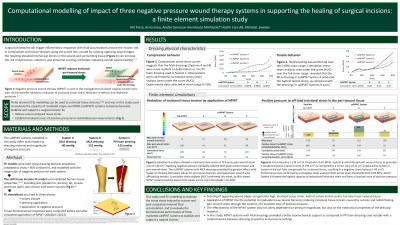
A soft tissue incision FE model was developed using validated human tissue properties. The models of the NPWT systems incorporated the physical characteristics of the dressings, multilayer absorptive (MLA) or peel-and-place (PP) foam dressings, with the intended negative pressure -80 or -125 mmHg. Simulations were conducted in three phases: suture closure, dressing application, and activation of negative pressure (ABAQUS v2022). Read-out focused on reduction of suture-induced strain and the ability of NPWT systems to generate a localized zone of positive pressure to counteract peri-wound stress.
Results:
The MLA dressing-based NPWT systems demonstrated superior performance in reducing suture strain, from baseline at 71% maximal strain without NPWT to 27% at -80 mmHg and 38% at -125 mmHg. The PP foam dressing-based system at -125 mmHg reduced suture tension to 56% strain. For management of incisional peri-wound stress, the MLA dressing-based system at -125 mmHg generated a localized positive pressure zone of 194 cm³ (from baseline 128 cm3) significantly larger than the 22 cm³ achieved with the PP foam dressing-based system. The NPWT system with MLA dressing at -80 mmHg could not compensate for the incisional stress, resulting in a net negative stress balance (-49 cm³).
Discussion:
This study highlights that both dressing material design and magnitude of applied negative pressure are key factors in NPWT with respect to the capacity of a NPWT system to mitigate incisional tissue tension and peri-wound stress. In specific, dressings with higher deformability and lower structural resilience, showed limitations in delivering targeted mechanical offloading. Here, the MLA dressing-based system with -125 mmHg, provided superior biomechanical support by simultaneously reducing tissue tension along the incision line and the surrounding peri-wound tissue, critical for promoting wound healing.