(CS-001) Addressing Infection Risk and Pain in Hard-to-Heal Wounds with a Bioresorbable Antimicrobial Matrix Containing Lidocaine HCl
Friday, April 10, 2026
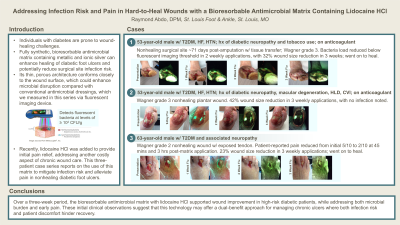
Introduction: Individuals with diabetes are prone to wound-healing challenges such as infection and dehiscence, and advanced diabetic foot ulcers may persist for months without intervention. A fully synthetic, resorbable antimicrobial matrix incorporating both ionic and metallic silver has demonstrated the ability to promote closure of diabetic ulcers and may help lower infection rates following surgery. Its thin, porous architecture conforms closely to the wound surface, which could enhance microbial disruption compared with conventional antimicrobial dressings. Recently, lidocaine HCl was added to provide initial pain relief, addressing another costly aspect of chronic wound care. This three-patient case series reports on the use of this matrix to mitigate infection risk and alleviate pain in nonhealing diabetic foot ulcers.
Methods: Three patients aged 53–63 years presented with Wagner grade 2 or 3 ulcers and multiple comorbidities known to impair healing, including diabetes, cardiovascular conditions, and the use of anticoagulants. Bacterial presence was identified via non-contact fluorescence imaging before debridement. Following excisional debridement, the matrix was applied per manufacturer instructions and secured with petrolatum gauze and adhesive strips. The matrix was then applied following manufacturer guidelines and secured with petrolatum gauze and adhesive strips. Alginate, dry gauze, and compression dressings were placed, and patients were instructed to offload. At weekly visits, clinicians reassessed and re-debrided wounds as needed, reapplied the matrix, and measured local tissue oxygenation using near-infrared spectroscopy.
Results: Across all three patients, wound depth and surface area progressively decreased, accompanied by visible granulation tissue formation. In the two cases with initial positive fluorescence, bacterial signal was no longer detectable after treatmentafter management with the matrix. In the non-neuropathic patient, reported pain decreased from 5 to 2 on a 10-point scale at 45 minutes and three hours post-application. Tissue perfusion remained sufficient throughout follow-up.
Discussion: Over a three-week period,the bioresorbable antimicrobial matrix with lidocaine HCl supported wound improvement in high-risk diabetic patients, while addressing both microbial burden and early pain. These initial clinical observations suggest that this technology may offer a dual-benefit approach for managing chronic ulcers where both infection risk and patient discomfort hinder recovery.

.jpg)