(CS-039) Evaluation of the Wound Care Dressing* (Xlta) Through a Retrospective Clinical Case Study
Friday, April 10, 2026
James Lin, D.O. – Clinical Practice of LECOM Institute for Successful Living; George Munro, LPN WCC – Regional Wound Care Coordinator, LECOM Institute for Successful Living
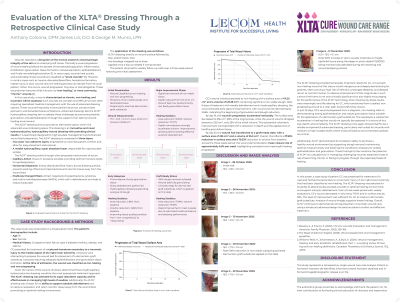
Introduction: Chronic and non-healing wounds pose substantial clinical challenges, particularly in patients with multiple comorbidities that impair perfusion, inflammation control, and tissue regeneration. Traumatic hematomas of the lower extremity often progress to non-healing wounds due to devitalized tissue, excessive exudate, and delayed granulation. Advanced dressings that support moisture balance, autolytic debridement, and bioburden reduction may accelerate wound bed preparation. The topical wound care hydrocapillary, hydroconductive dressing* is engineered to rapidly manage exudate, sequester necrotic tissue, and promote epithelialization through capillary action, horizontal dispersion, and positively charged fibers. This case study evaluates its clinical effectiveness in a complex, non-healing traumatic wound.
Methods: An 81-year-old female with a history of congestive heart failure, type II diabetes mellitus, obesity, and edema presented with a ruptured hematoma on the right medial lower extremity, initially measuring 411.25 cm² (surface area) and 123.38 cm³ (volume). The wound was classified as non-healing and contained extensive slough. The topical wound dressing* was applied directly to the wound beneath a non-stretch Kerlix and Ace wrap, with weekly clinical evaluations over 35 days. Wound measurements, tissue characteristics, and photographic assessments were recorded.
Results: By day 9, early granulation was evident with a 2.86% reduction in both area and volume. By day 16, wound area decreased to 336 cm² (18.3% reduction), while volume decreased to 33.6 cm³ (72.8% reduction), reflecting rapid depth normalization and significant slough clearance. By day 23, the wound achieved 100% slough removal and was deemed graft-ready. At day 35, overall reductions reached 45.3% in surface area and 81.8% in volume, with a mean closure rate of 8.8% per week.
Discussion: In this large, complex traumatic wound, the topical wound dressing* demonstrated clinically meaningful improvement by accelerating autolytic debridement, managing exudate effectively, and enabling timely progression to dermal grafting. These findings support Xlta™ as a promising advanced dressing option for high-exudate, non-healing wounds.

.jpg)