(CS-035) Beyond Debridement: Limb Salvage in Severe Necrotizing Fasciitis Using Soft Tissue Expansion and Bioabsorbable Temporizing Matrix
Friday, April 10, 2026
Ilya Makarovskiy, DPM
Introduction: Diabetic foot infections remain a major cause of morbidity, often progressing rapidly to deep soft tissue involvement and threatening limb viability. Early recognition and aggressive surgical management are essential to prevent systemic deterioration and preserve function. Despite advances in wound care, achieving durable closure in the setting of extensive infection and tissue loss remains challenging. This case highlights the role of aggressive early and closely spaced debridements, combined with adjunctive reconstructive modalities, in successfully achieving limb salvage and accelerated healing.
Methods: A 65‑year‑old male with poorly controlled diabetes mellitus (A1C 13.9%) and prior left foot amputations presented with progressive pain, swelling, and ulceration of the left foot. Laboratory evaluation confirmed diabetic ketoacidosis with hyperglycemia, elevated anion gap, and markedly elevated inflammatory markers (CRP 398.8, WBC 16.9). Imaging revealed a plantar ulcer with rim‑enhancing abscess extending into the abductor hallucis and extensor tendonswith fascial fluid tracking concerning for early necrotizing infection. On physical examination, there was a plantar forefoot ulcer with necrotic tendon exposed, purulent drainage, malodor, and increased warmth. The patient was initiated on broad‑spectrum intravenous antibiotics, insulin infusion, and admitted to the intensive care unit for management of diabetic ketoacidosis and severe infection.
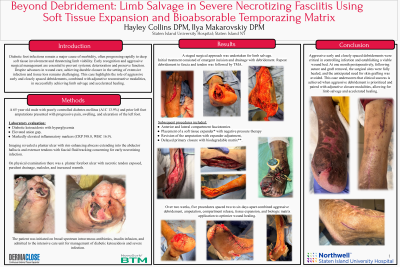
Results: A staged surgical approach was undertaken for limb salvage. Initial treatment consisted of emergent incision and drainage with sharp debridement. Repeat debridement to fascia and tendon was followed by transmetatarsal amputation. Subsequent procedures included anterior and lateral compartment fasciotomies, placement of a soft tissue expander* with negative pressure therapy, revision of the amputation with expander adjustment, and delayed primary closure with biodegradable matrix**. Over two weeks, five procedures spaced two to six days apart combined aggressive debridement, amputation, compartment release, tissue expansion, and biologic matrix application to optimize wound healing.
Discussion: Aggressive early and closely spaced debridements were critical in controlling infection and establishinga viable wound bed. At one month postoperatively, following suture and graft removal, the surgical sites were fully healed, and the anticipated need for skin grafting was avoided. This case underscores that clinical success is achieved when aggressive debridement is prioritized and paired with adjunctive closure modalities, allowing for limb salvage and accelerated healing.

.jpg)