Introduction: Hospital-acquired pressure injuries (HAPIs) can occur in patients due to prolonged pressure on the skin and deep tissues. Clinical studies have shown that individuals with dark skin tones (DST) have higher rates of later stage pressure injuries (PIs) compared to light skin toned individuals due to lack of early PI stage recognition. Proper training and skin assessment are necessary to improve the recognition of earlier stages of PIs in DST in order to prevent later stages of PI from developing.
Methods: This study was conducted on 85 patients with DST at a 495-bed hospital located in New York, NY. The goal was to reduce the monthly rate of HAPIs to 1.58 per 1000 patient days/month following implementation of the PTRS during a 10-month study. In addition, the hospital staff received educational training on the skin assessment of DST that was based on the Monk Skin Tone Scale (MSTS) ranging from 1-10 with 10 being the darkest skin tone.
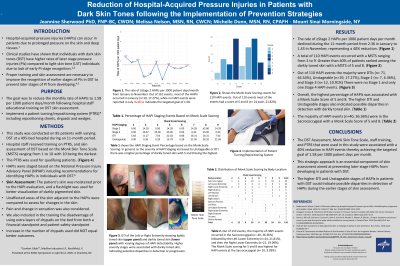
Results: A total of 110 HAPI events were evaluated with a MSTS ranging from 2 to 9. Greater than 40% of patients ranked among the darker skin tones with a MSTS of 8 and 5. Higher HAPI severity stages were associated with DST indicating possible disparities in detection. Out of 110 HAPIs, the majority (n=71) were Deep Tissue Injuries (DTIs) and Unstageable (n=19) with the majority occurring in the sacral region. The rate of ≥Stage 2 HAPIs per 1000 patient days/month declined during the first 10 months from 2.36 in January to 1.27 in October, representing a 50.4% reduction.
Discussion: The strategy of educating hospital staff on DST skin assessment along with implementation of the PTRS was shown to reduce the rate of HAPIs by 50.4% thereby achieving the targeted goal of 1.58 per 1000 patient days/month. This strategic approach is an essential component of skin assessment aimed at preventing late-stage PIs in patients with DST.

.jpg)