
.jpg)
Practice Innovations
War-related injuries, including blast injuries, burns and penetrating gunshot or shrapnel wounds, result in severe pain, prolonged recovery/return to duty (RTD)1. Combat hospitals are resource constrained, underscoring the need for more efficient wound management solutions2. Conventional wound care requires frequent dressing changes, increasing patient discomfort, and draining medical resources. Transforming powder dressing (TPD) offers an innovative solution that can stay in place for extended periods (up to 30 days). This case series examines TPD’s impact on dressing change frequency and associated pain when treating acute traumatic combat wounds.
Methods:
Seven cases were analyzed, covering acute traumatic combat injuries from burn, gunshot, shrapnel and blast injuries. All cases were treated with TPD in place of traditional dressings. TPD is comprised primarily of methacrylate-based polymers similar to those used in contact lenses. Upon hydration, TPD granules aggregate to form a moist, oxygen-permeable barrier that protects the wound from exogenous bacteria while allowing excess exudate to flow through via vapor transpiration. Simple secondary dressings may be used to cover the wounds in areas of high-exudation or friction. TPD can be topped off by sprinkling more powder without removal for up to 30 days, reducing dressing changes, especially for hard-to-dress wounds. As healing progresses, it dries and naturally flakes off.
Results:
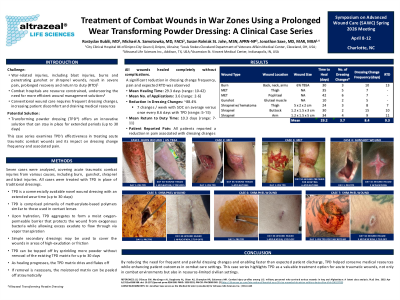
All wounds healed fully without complications. Significant reduction in dressing change frequency, pain and hospital stays was observed. On average, the wounds healed in 29.3 days (range: 10-42) with 3.6 applications of TPD (range: 2-6 including top-offs). Dressing change frequency was reduced from seven times a week to once every 8.6 days on average (range: 5-15). RTD was reported for four cases and was lower than anticipated in each case, averaging 10.3 days overall (range: 7-11). Pain associated with dressing changes was reduced in all cases.
Discussion: