
.jpg)
Case Series/Study
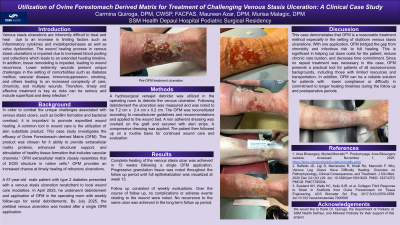
A 61-year-old male with venous stasis and diabetes mellitus presented with a right pretibial venous ulceration. The patient underwent surgical debridement and application of ovine forestomach–derived matrix (OFM) in the operating room in April 2025 and continued weekly follow-ups for serial debridements. The ulcer healed by July 2025 after only one OFM application. Venous stasis ulcerations tend to be refractory to treatment due to decreased cell turn over, higher risk for biofilm formation and infection, and in turn delayed tissue repair. OFM was selected in this case as it provides extracellular matrix proteins which improve cellular integrity, provide structural support, and facilitate new vascular channels that aid in tissue formation. This targets the complex root problem that venous stasis ulcers present. OFM creates an environment that promotes a successful mechanism for healing chronic wounds. This in turn reduces the need for repeated interventions.
Methods: The venous stasis ulceration was debrided in the operating room utilizing a Versajet hydrosurgical debrider. Post-debridement and prior to application of the graft, the ulcer measured 7.2 cm x 2.4 cm x 0.2 cm. OFM graft was reconstituted with saline per manufacturer recommendations and applied to the wound bed. A nonadherent dressing was placed and secured with Steri-Strips, followed by a compressive dressing.
Results: The patient achieved complete healing of the venous stasis ulcer in 13 weeks following a single OFM application. The ulcer demonstrated progressive granulation tissue formation and complete epithelialization by week 13. Over the course of treatment, consisting of weekly clinical evaluation, it was found that the wound decreased in size without any infectious complications or adverse reactions to the substitute. In addition to successful healing, no recurrence to the same ulcer was achieved in the long-term follow up period.
Discussion: This case demonstrates that OFM is an effective and practical option for managing complex venous stasis ulcerations. Healing after a single application highlights its potential cost-effectiveness and minimal need for repeat treatment. OFM is a reliable option for patients with limited resources or a history of low compliance during the follow up phase of care.