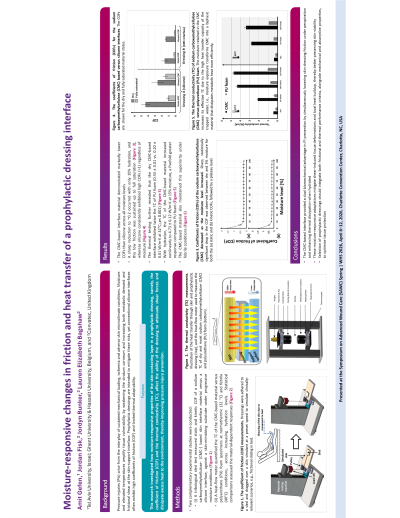
Introduction: Pressure injuries often develop when sustained soft tissue loading, inflammation, ischemia and an unfavorable skin microclimate interact. Prophylactic dressings are used to protect high-risk body regions, yet conventional silicone interfaces often maintain high coefficients of friction (COF) and have limited adaptability to changing moisture conditions.1 This study evaluated how a sodium carboxymethylcellulose (CMC)-based skin-contact layer* responds to hydration in terms of friction and thermal conductivity (TC), with potential implications for pressure injury prevention (PIP).
Methods: Two complementary experiments were conducted to evaluate frictional and thermal responses to increasing moisture levels at the skin-contact dressing layer. The friction testing used a tribological sled to measure the static and kinetic COF for a CMC-based interface* and a silicone interface, against a skin-simulating substrate under progressively increasing hydration. Thermal testing employed a heat-flow meter to quantify the TC of the CMC material versus polyurethane (PU) foam at 32°C and 40°C (representingnormothermic and febrile conditions), under increasinghydration. Statistical analyses compared material-dependent responses under identical conditions.
Results: he CMC-based interface*exhibitedsignificantly and consistently lower COFs than silicone at all the evaluated moisture levels above zero. With only 10% hydration, the COF decreased sharply to approximately 0.2, and this low-friction state wasmaintained up to full saturation,whereas silicone interfacesexhibitedsubstantially higherCOF values ( >1) regardless of the hydration level. In parallel, the TC of the dry CMC-based interface* was double that of PU foam at 32°C (0.43 ± 0.01 versus 0.20 ± 0.01 W/m·K; p< 0.001). With increasing hydration, the TC of the CMC-based material rose nonlinearly to 4.73 ± 0.12 W/m·K at 15% moisture and 32°C, representing a more than fivefold greater response than PU foam. This TC advantage also persisted under simulated febrile conditions (40°C).
Discussion: The CMC-based skin-contact dressing* materialdemonstrateda superiordualbiomechanical advantage, by concurrently lowering potentialskin-dressing frictionalforcesand improving the heat clearance(flux) from skin in response torelatively lowhydration exposures, characteristic to natural perspiration.This moisture-driven material responsiveness helps reduce the shear-induced tissue deformations and also limits local heat buildup under the dressing, supporting skin integrity under loading. Thus,the friction and thermal performance should be considered, along with fluid handling and mechanical properties, when designing or selecting prophylactic dressings for PIP.

.jpg)