(EBP-014) Near-Infrared Spectroscopy Imaging in Chronic Wound Care: A Comprehensive Review of Clinical Applications and Healing Insights
Friday, April 10, 2026
Alex Ortega-Loayza, MD, MCR; Holly Korzendorfer, PT, PhD, CWS; Francis James, BFA; Peggy Dotson, RN, BS; Anna Khimchenk, PhD, MBA; Vickie Driver, DPM, MS, FACFAS; Sharon Sonenblum, PhD
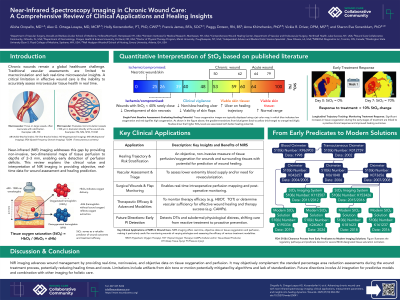
Introduction: Chronic wounds remain a global healthcare challenge.¹ A critical limitation in effective wound care is the inability to accurately assess microvascular tissue health in real time. Near-infrared (NIR) imaging addresses this gap by providing noninvasive, two-dimensional maps of tissue perfusion to depths of 2–3 mm, enabling early detection of perfusion deficits. This abstract builds upon a recent literature review² of NIR imaging and its use in wound care, including relevant clinical endpoints and key measurement parameters assessed.
Methods: The aim is to identify, describe, and illustrate NIR imaging modalities and measurement parameters, along with their clinical applications. A literature review of 80 peer-reviewed publications and regulatory documents was conducted to assess NIR imaging use in wound care. Publications included20 clinical studies (patient cohorts n=15–81) and systematic reviews/meta-analyses, while regulatory documents included FDA 510(k) clearances for Class II devices. The review examined NIR imaging principles, historical development, and modern implementations. FDA-cleared devices and clinical applications across wound etiologies were analyzed and synthesized to summarize current evidence.
Results: Clinical studies demonstrated that NIR imaging can effectively detect poor wound healing early, facilitating timely interventions. Changes in parameters such as oxygenated hemoglobin, deoxygenated hemoglobin, and tissue oxygen saturation have shown strong correlations with wound healing progress, enabling clinicians to make more informed decisions. Findings indicate that NIR provides evidence-based measures of tissue perfusion that can inform patient-specific care.
Discussion: NIR imaging advances wound management by providing real-time, noninvasive, and objective data on tissue oxygenation and perfusion. It may objectively complement the standard percentage area reduction assessments during the wound treatment process, potentially reducing healing times and costs. Limitations include artifacts from skin tone or motion (potentially mitigated by algorithms) and lack of standardization. Future directions involve AI integration for predictive models and combination with other imaging for holistic care

.jpg)