
.jpg)
Laboratory Research
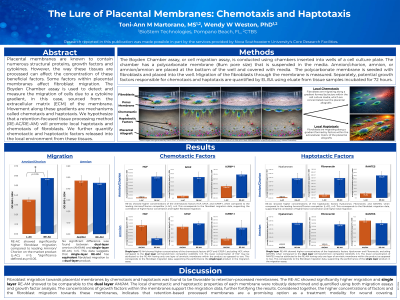
Placental membranes are known to contain numerous structural proteins, growth factors and cytokines. However, the way these tissues are processed can affect the concentration of these beneficial factors. Some factors within placental membranes affect fibroblast migration. The Boyden Chamber assay is used to detect and measure the migration of cells, such as fibroblasts, due to a cytokine gradient, in this case, sourced from the extracellular matrix (ECM) of the membrane. Movement along these gradients are mechanisms called chemotaxis and haptotaxis. We hypothesize that a retention-focused tissue processing method (RE-AC/RE-AM) will promote haptotaxis and chemotaxis of fibroblasts. We further quantify chemotactic and haptotactic factors released from these tissues.
Methods:
The Boyden Chamber assay, or cell migration assay, is conducted using chambers inserted into wells of a cell culture plate. The chamber has a polycarbonate membrane (8um pore size) that is suspended in the media. Amnion/chorion, amnion, or amnion/amnion are placed at the bottom of the well and covered with media. The polycarbonate membrane is seeded with fibroblasts and placed into the well. Migration of the fibroblasts through the membrane is measured. Separately, potential growth factors responsible for chemotaxis and haptotaxis are quantified by ELISA.
Results:
More cell migration occurred in wells containing membranes with retention-based processing. These membranes had higher concentrations of chemotactic factors such as HGF, IGF, and FGF. Haptotactic factors such as fibronectin, HA, and RANTES were also in higher concentration in RE-AC/RE-AM membranes.
Discussion:
All membranes used for the migration assay were submerged in DMEM without serum or other additions. This means that the membranes are responsible for any gradients. Hence, the chemotactic and haptotactic properties of each membrane were robustly determined. The quantification of growth factors within the membranes supports the migration data, further supporting the results. The retention-processed membranes show a higher rate of migration and a higher chemotactic and haptotactic factor concentration than other membranes tested. These findings suggest that retention-based processed membranes are a superior option as a treatment modality for wound covering.