(LR-031) Recreating morphogenesis with sound: a new paradigm for regenerative
Friday, April 10, 2026
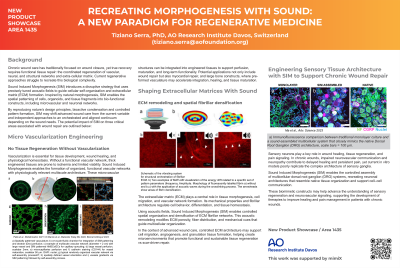
Introduction: Functional tissue repair requires more than wound closure; it depends on the coordinated regeneration of vascular, neural, and structural networks. Current regenerative approaches struggle to recreate this complexity. Sound Induced Morphogenesis (SIM) introduces a new paradigm by using precisely tuned acoustic fields to guide cellular self-organization and extracellular matrix (ECM) formation. Inspired by natural morphogenesis, SIM applies physical acoustic forces to orchestrate spatial patterning, enabling living constructs that mirror native repair processes.
Methods: Multicellular systems containing endothelial, mesenchymal, and neuronal cells were exposed to structured acoustic fields within hydrogels and fluidic environments. Standing waves induced controlled cell condensation and pattern formation, stabilized through matrix crosslinking. Outcomes were evaluated using microscopy, immunostaining, and functional assays assessing network formation, alignment, and maturation. Unpatterned controls were used for comparative analysis.
Results: SIM enabled cells to self-organize into architectures resembling early developmental patterns. Endothelial cells formed interconnected microcapillary networks, while neuronal populations assembled into organized ganglion-like structures with enhanced functional synchronization driven by improved spatial arrangement. Patterned and acoustically stimulated mesenchymal stromal cells showed modulatable gene expression and transcription factor activity. These coordinated interactions generated physiologically relevant gradients of oxygen, nutrients, and signaling molecules. Across all models, SIM constructs demonstrated accelerated maturation, improved functional integration, and required up to ten times fewer cells than conventional random assemblies—highlighting unprecedented efficiency in initiating regenerative processes.
Discussion: Sound Induced Morphogenesis provides a unifying physical framework for tissue regeneration, linking wound closure to functional repair. By applying acoustic energy to recapitulate natural morphogenetic principles, SIM enables scalable, contactless, and cell-efficient assembly of complex tissues. This technology addresses long-standing challenges in vascularization, innervation, and tissue maturation and opens a pathway toward regenerative strategies that extend beyond traditional repair and approach true biological regeneration.

.jpg)