
.jpg)
Practice Innovations
Introduction:
Clinicians encounter an average of 11 clinical questions daily, most of which remain unanswered1. While artificial intelligence (AI) holds promise2, unconstrained generative AI for diagnoses or treatment plans presents significant risks of patient harm and malpractice liability. In typical clinical decision-making, AI achieves an accuracy of only ~52%, frequently failing to identify life-threatening conditions3. To mitigate these risks and provide reliable, evidence-based answers in wound care, we aimed to develop a responsible, AI-powered, point-of-care clinical intelligence solution leveraging a Portuguese wound care society’s digital clinical pathways.
Methods:
Method:
Using Design Thinking4 , the solution was developed as a module within a decision support platform.
● One year after the wound care society turned their printed pocket guide library into a comprehensive, multi-media digital clinical pathways library, an evaluation revealed that while 86% of members found the pathways helpful, access was cumbersome5.
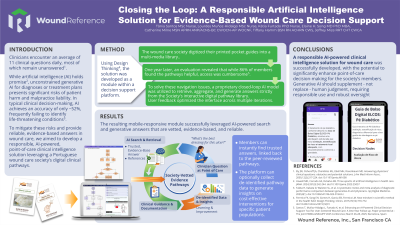
● To solve these navigation issues, a proprietary closed-loop AI model was utilized to retrieve, aggregate, and generate answers strictly from the Society's interactive digital pathway library.
User feedback optimized the interface across multiple iteration
Results:
Results:
The resulting mobile-responsive module successfully leveraged AI-powered search and generative answers that are vetted, evidence-based, and reliable. Members can instantly found trusted answers, linked back to the peer-reviewed pathways. Unlike open-AI models, this closed-loop solution effectively curbs hallucinations, providing only referenced and society-vetted answers. Additionally, the platform optionally collects de-identified pathway data to generate insights on cost-effective interventions for specific patient populations.
Discussion:
Discussion: A responsible AI-powered clinical intelligence solution for wound care was successfully developed, with the potential to significantly enhance point-of-care decision-making for the society’s members. Generative AI should supplement - not replace - human judgment, requiring responsible use and robust oversight.