
.jpg)
Case Series/Study
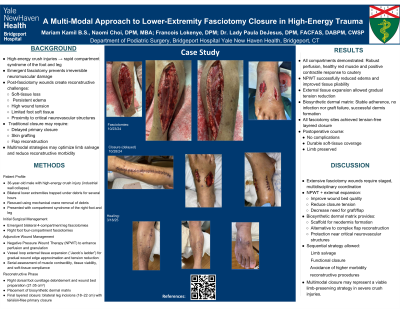
The patient was trapped in construction debris for hours prior to rescue and underwent emergent bilateral leg fasciotomies and right foot four-compartment fasciotomies to relieve compartmental pressure and maintain tissue viability. Negative pressure wound therapy (NPWT) was initiated postoperatively to control edema, enhance perfusion, and promote granulation tissue formation. Vessel loop external tissue expanders were applied to the leg fasciotomy sites to facilitate gradual wound edge approximation. Serial evaluations monitored compartment viability, muscle contractility, and soft-tissue compliance. When the right dorsal foot wounds developed healthy granulation tissue, surgical bed preparation was performed, followed by placement of a biosynthetic dermal matrix to promote neodermis development. As edema resolved and soft-tissue flexibility improved, layered closure of the foot and leg fasciotomy wounds was achieved.
Results:
Serial intraoperative assessments confirmed robust perfusion and contractile response in all compartments of both legs and the right foot. The biosynthetic dermal matrix demonstrated stable adherence to the wound bed with no evidence of infection, graft failure, or tissue compromise. All fasciotomy sites achieved tension-free primary layered closure. The postoperative course remained complication-free, and all wounds maintained durable, healthy soft-tissue coverage throughout follow-up.
Discussion:
Extensive fasciotomy wounds of the leg and foot require a sequential, multidisciplinary approach involving podiatry and general surgery. The combination of NPWT, external tissue expansion, and biosynthetic dermal matrix application optimized wound closure, preserved limb integrity, and reduced the need for complex flap reconstruction. This staged strategy represents a viable option for managing severe lower-extremity compartment syndromes with complex soft-tissue loss from crush injuries.