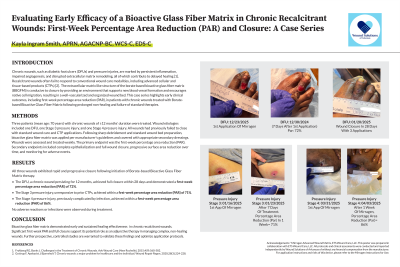
(CS-071) Evaluating Early Efficacy of a Borate Based Bioactive Glass Fiber Matrix in Chronic Recalcitrant Wounds: First-Week Percentage Area Reduction (PAR) and Closure: a Case Series
Friday, April 10, 2026
Introduction: Chronic wounds, such as diabetic foot ulcers (DFUs) and pressure injuries, are marked by persistent inflammation, impaired angiogenesis, and disrupted extracellular matrix remodeling, all of which contribute to delayed healing [1]. Recalcitrant wounds often fail to respond to conventional wound care modalities, including advanced cellular and tissue-based products (CTPs) [2]. The extracellular matrix like structure of the borate based bioactive glass fiber matrix (BBGFM) is conducive to closure by providing an environment that supports new blood vessel formation and encourages native cell migration, resulting in a well-vascularized and organized wound bed. This case series highlights early clinical outcomes, including first-week percentage area reduction (PAR), in patients with chronic wounds treated with Borate-based Bioactive Glass Fiber Matrix following prolonged non-healing and failure of standard therapies.
Methods: Three patients (mean age: 70 years) with chronic wounds of ≥12 months’ duration were treated. Wound etiologies included one DFU, one Stage 3 pressure injury, and one Stage 4 pressure injury. All wounds had previously failed to close with standard wound care and CTP applications. Following sharp debridement and standard wound bed preparation, bioactive glass fiber matrix was applied per manufacturer’s guidelines and covered with appropriate secondary dressings. Wounds were assessed and treated weekly. The primary endpoint was the first-week percentage area reduction (PAR). Secondary endpoints included complete epithelialization and full wound closure, progressive surface area reduction over time, and monitoring for adverse events.
Results: All three wounds exhibited rapid and progressive closure following initiation of Borate-based Bioactive Glass Fiber Matrix therapy. - The DFU, a chronic wound persisting for 12 months, achieved full closure within 28 days and demonstrated a first-week percentage area reduction (PAR) of 72%. - The Stage 3 pressure injury, unresponsive to prior CTPs,achieved within a first-week percentage area reduction (PAR) of 71%. - The Stage 4 pressure injury, previously complicated by infection, achieved within a first-weekpercentage area reduction (PAR) of 86%. No adverse reactions or infections were observed during treatment
Discussion: Bioactive glass fiber matrix demonstrated early and sustained healing effectiveness efficacy in chronic recalcitrant wounds. Significant first-week PAR and full closure support its potential role as an adjunctive therapy in managing complex, non-healing wounds. Further prospective, controlled studies are warranted to validate these findings and optimize application protocols.

.jpg)