(CS-055) Reviving Stalled Wounds: A Case Series on the Clinical Impact of a Borate-Based Bioactive Glass Fiber Matrix in Complex Patients
Friday, April 10, 2026
Introduction: Chronic and complex wounds present significant clinical challenges, particularly in medically fragile populations. Advanced wound care products are increasingly being used to stimulate healing in wounds that are refractory to standard interventions. A critical step in this process is wound bed preparation—removing nonviable tissue, managing exudate, and optimizing the local wound environment to facilitate granulation and epithelialization.1-3 This case series evaluates the use of a Borate-Based Bioactive Glass Fiber Matrix (BBGFM) in three diverse patients with non-healing wounds, highlighting the skin substitute’s role in potentially facilitating proper wound bed preparation, formation and eventual wound closure
Methods: Three patients with complex wounds were treated with BBGFM following periods of stalled healing. Clinical context, wound characteristics, and comorbidities were recorded. Wound progression was monitored through serial measurements and photographic documentation. The BBGFM was applied per manufacturer guidelines until closure or evidence of meaningful progression was observed
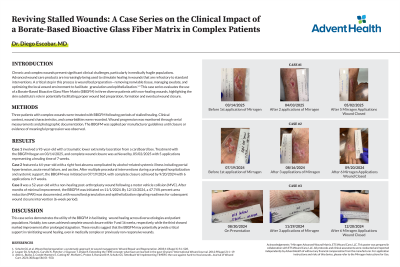
Results: Case 1 involved a 93-year-old with a traumatic lower extremity laceration from a cardboard box. Treatment with the BBGFM began on 03/14/2025, and complete wound closure was achieved by, 05/02/2025 with 5 applications representing a healing time of 7 weeks. Case 2 featured a 64-year-old with a right foot abscess complicated by alcohol-related systemic illness including portal hypertension, acute renal failure, and ascites. After multiple procedural interventions during a prolonged hospitalization and systemic support, the BBGFM was initiated on 07/19/2024, with complete closure achieved by 9/20/2024 with 6 applications in 9 weeks. Case 3 was a 52-year-old with a non-healing post-arthroplasty wound following a motor vehicle collision (MVC). After months of minimal improvement, the BBGFM was initiated on 11/1/2024. By 12/13/2024, a 47.74% percent area reduction (PAR) was documented, with wound bed granulation and epithelialization signaling readiness for subsequent wound closure intervention (6-week period)
Discussion: This case series demonstrates the utility of the BBGFM in facilitating wound healing across diverse etiologies and patient populations. Notably, two cases achieved complete wound closure within 9 and 16 weeks, respectively, while the third showed marked improvement after prolonged stagnation. These results suggest that the BBGFM may potentially provide critical support in reinitiating wound healing, even in medically complex or previously non-responsive wounds.

.jpg)