
.jpg)
Clinical Research
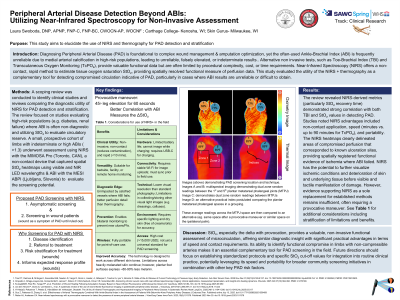
A scoping review was conducted to identify clinical studies and reviews comparing the diagnostic utility of NIRS for PAD detection and stratification. The review focused on studies evaluating high-risk populations (e.g., diabetes, renal failure) where ABI is often non-diagnostic, and utilizing St02 to evaluate circulatory reserve.
Clinical Cohort: A small, prospective cohort of limbs with indeterminate or high ABIs ( >1.3) underwent assessment using NIRS with the MIMOSA Imager (Toronto, CAN) & ABI with the MESI ABPI (Ljubljana, Slovenia). The MIMOSA Imager is a non-contact device that captured spatial StO2 heatmaps using visible and NIR LED wavelengths.
Results: The review revealed NIRS-derived metrics (particularly StO2 recovery time) demonstrated strong correlation with both TBI and StO2 values in detecting severe PAD/CLI. Studies noted NIRS advantages included non-contact application, speed (minutes vs. up to 90 minutes for TcPO2, and portability. The NIRS heatmaps clearly delineated areas of compromised perfusion that corresponded to known ulceration sites, providing spatially-registered functional evidence of ischemia where ABI failed. However, evidence supporting NIRS as a sole replacement for established methods remains insufficient, often requiring a provocative maneuver for high sensitivity requiring further definition.
Discussion: NIRS-derived St02 provides a valuable, non-invasive functional assessment of microcirculation, offering similar diagnostic insight with significant practical advantages in terms of speed and contact requirements. Its ability to identify functional compromise in limbs with non-compressible arteries makes it an essential complementary tool for PAD screening in the field. Future directions should focus on establishing standardized protocols and specific StO2 cut-off values for integration into routine clinical practice, potentially leveraging its speed and portability for broader community screening initiatives in combination with other key PAD risk factors.