(CS-157) Use of a Dehydrated Amnion/Chorion Membrane Improves Lower Leg Surgical Wound Healing: A Four-Case Series
Friday, April 10, 2026
Leela Raj, BA – Pre-Doctoral Research Fellow, Dermatology, University of Pennsylvania; Christopher Richter, BS – Pre-Doctoral Research Fellow, Dermatology, University of Pennsylvania; H. William Higgins, MD, MBE – Associate Professor of Clinical Dermatology, Dermatology, University of Pennsylvania
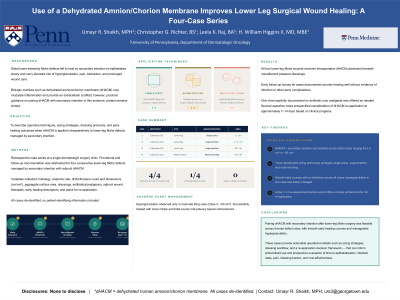
Introduction: Distal lower-extremity wounds left to heal by secondary intention after cutaneous oncology excision often re-epithelialize slowly and are prone to hypergranulation, pain, and bioburden. Biologic matrices such as dehydrated amnion/chorion membrane (dHACM)* may modulate inflammation and provide an extracellular scaffold, yet practical details for pairing dHACM with secondary intention after Mohs micrographic surgery are limited.
Methods: We performed a retrospective case series at a dermatologic surgery clinic, abstracting procedural and follow-up documentation for four consecutive lower-leg Mohs defects intentionally managed by secondary intention with adjunct dHACM. Variables included histology, anatomic site, dHACM piece count and total dimensions (cm/cm²), aggregate surface area, dressings, antibiotics/analgesics, adjunct wound therapies, early healing descriptors, and plans for re-application. Cases were de-identified; no patient-identifying information is included.
Results: Four lower-leg Mohs wounds received intraoperative dHACM placement beneath nonadherent pressure dressings. Utilization followed three observable patterns: single-piece application (n=1) for a compact defect (2 cm²); single-site multi-piece augmentation (n=2), defined as multiple dHACM pieces applied to a single irregular wound bed (examples: 3×2 cm plus 1.6 cm² [~7.6 cm² total] and two pieces documented as 20 cm² and 8 cm² on the same operative date); and multi-site tiling (n=1), defined as distribution of multiple dHACM pieces across distinct defects, for extensive bilateral shin disease (aggregate ~50 cm²).
Early follow-up across all cases documented wounds healing well without evidence of infection or other early complications. Hypergranulation was observed only in the multi-site tiling case and was successfully treated with silver nitrate and a brief course of mid-potency topical corticosteroid. One chart explicitly documented no antibiotic use; analgesia was offered as needed. Several operative notes prespecified consideration of dHACM re-application at approximately 7–14 days based on clinical progress.
Discussion: In this clinic-based series, pairing dHACM with secondary intention after lower-leg Mohs was feasible across diverse defect sizes, with smooth early courses and manageable hypergranulation. The cases outline actionable techniques for sizing (single piece, augmentation, tiling), dressing workflow, and a simple re-application decision at day 7–14. These operational details can inform protocolized use and prospective evaluation of time to epithelialization, infection, pain, dressing burden, and cost-effectiveness.

.jpg)