(CR-070) Multi-Center, Single-Arm, Prospective Clinical Study Investigating the Safety and Effectiveness of Ovine Forestomach Matrix in the South Asian Population
Friday, April 10, 2026
Barnaby May, PhD
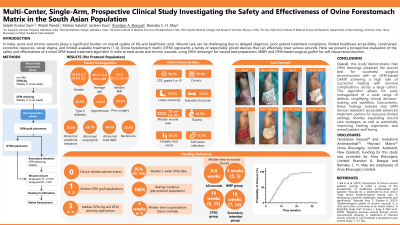
Introduction: In India, both acute and chronic wounds place a significant burden on overall quality of life and healthcare costs. However, chronic wounds are notoriously difficult to treat due to delayed diagnosis, poor patient treatment compliance, limited healthcare accessibility, constrained economic resources, and social stigma [1-3]. Also, wound care treatments are limited, particularly in rural areas, increasing overall morbidity [4]. Ovine forestomach matrix (OFM) represents a responsibly priced graft that can effectively treat various wounds but remains under-researched among Indian communities. Here, we present a prospective evaluation of OFM safety and effectiveness in India.
Methods: One hundred patients with acute or chronic wounds were prospectively enrolled from four medical centers in India. Treatment included antimicrobial single-layer OFM (twice weekly) to manage underlying inflammation and infection, followed by natural single-layer OFM (weekly) to promote the proliferative phase of healing and finally surgical placement of a multi-layer OFM device to induce vascularized tissue formation. Definitive closure was accomplished either through split-thickness skin grafting (STSG), or via secondary intention with further natural single-layer OFM applications. Demographics, wound characteristics, healing outcomes, and adverse events were analyzed.
Results: Most patients were male, middle-aged and of normal weight. Wounds were primarily traumatic (41%), followed by diabetic foot ulcers (17%) and soft tissue infections (15%). Wounds were predominantly located on the lower extremities (82%), were clean-contaminated (72%), and chronic (median wound age of 4 weeks, IQR: 3, 9). Complete wound closure was achieved with a median of 9.02 (IQR: 5.56, 13.99) weeks. Full granulation tissue formation was attained in a median of 1.99 (IQR: 1.01, 2.13) weeks, and the median take of STSG at 1-week post-placement was 95 (IQR: 88.75, 100)%. No OFM-related adverse events were observed.
Discussion: Across a large prospective clinical trial, OFM supported complete wound closure without complications, despite the challenging-to-treat patient population. In fact, most patients had highly complicated, contaminated wounds. Moreover, this study demonstrated that different OFM grafts can be applied sequentially to promote different phases of healing. Overall, this study showed that OFM bioscaffolds are safe and effective for treating both acute and chronic wounds in the Indian population.

.jpg)