
.jpg)
Frostbite, while an uncommon diagnosis, is still one that wound care clinicians manage from time to time. Frostbite management can be elusive and at times unsettling. For best management of frostbite, it is fitting to take heart from the famous ice queen, and “let it go”. On a cellular level, frostbite occurs from the rapid freezing of cells, and subsequent inflammation from cell reperfusion, leading to cell death and necrosis.
Methods:
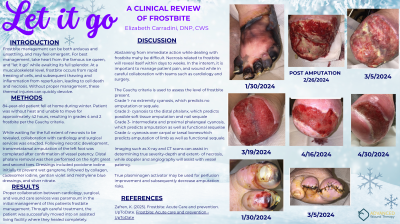
An 84-year-old woman, who was walker bound fell in her Oklahoma home during a particularly cold season. This patient was without heat, and unable to move from the floor where she stayed for nearly 42 hours, leading to grade 4 frostbite via the Cauchy criteria.
Results:
While waiting for the extent of necrosis to fully reveal itself, collaboration with cardiology and surgical services were used. After presentation to hospital, patient had X-ray to rule out fractures or foreign bodies, angiography for vessel patency, underwent right foot transmetatarsal amputation, and a partial left great and second toe amputation. Post amputation, wound dressings included collagen, cadexomer iodine dressings, gentian violet and methylene blue dressings, and several silver nitrate treatments for hypergranulation tissue. Patient then healed without consequence.
Discussion:
Necrosis related to frostbite will typically reveal itself within days to weeks, necessitating the need for mindful waiting. The Cauchy criteria is a useful tool when assessing degree of frostbite: Grade 1 presents no extremity cyanosis predicting no amputation or sequelae. Grade 2 presents cyanosis to the distal phalanx, predicting possible soft tissue amputation and nail sequelae. Grade 3 presents intermediate and proximal phalangeal cyanosis, predicting amputation and functional sequelae. Grade 4 presents cyanosis over carpal or tarsal bones predicting amputation of the limb and functional sequelae. Imaging such as X-ray and CT can aid determination of severity, depth, and extent of frostbite, while doppler and angiography can aid with vessel patency. Tissue plasminogen activator may also be used to improve perfusion and decrease amputation.