
.jpg)
Laboratory Research
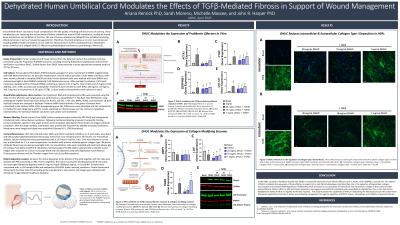
Uncontrolled fibrosis can lead to major complications with the quality of healing and the process of scarring. These complications are caused by the accumulation of excess extracellular matrix (ECM) components, leading to altered tissue architecture and inhibition of function. The use of human umbilical cord allografts has exhibited promising clinical outcomes in terms of wound management. Therefore, this study employs an in vitro macromolecular crowding (MMC) model to imitate an in vivo ECM-rich environment to further understand how a dehydrated human umbilical cord allograft (DHUC*) affects the pathobiological mechanisms contributing to fibrosis.
Methods:
DHUC was prepared using the PURION® process*, consisting of gentle cleansing, followed by lyophilization and terminal sterilization. Adult human dermal fibroblasts (HDFs) were cultured with media containing a mixture of Ficoll 70 kDa and Ficoll 400 kDa to induce MMC conditions. The impact of DHUC on the TGFβ-mediated pathway was evaluated by RT-PCR for pro-fibrotic effectors and proteins related to the regulation of ECM formation. Additionally, collagen deposition was assessed by western blot, immunofluorescence, and evaluation of deposited extracellular matrix.
Results:
Assessment of pro-fibrotic effectors show that HDFs treated with DHUC under MMC conditions and stimulated with TGFβ1 decreases the expression of genes that aid in myofibroblast differentiation, collagen regulation, ECM formation and crosslinking in comparison to the TGFβ control. DHUC also reduces the protein expression of alpha-smooth muscle actin (αSMA) along with ECM maturation and crosslinking proteins. Analysis of the extracellular matrix demonstrates that DHUC reduces the presence of both intracellular and extracellular collagen I.
Discussion:
This in vitro data further highlights the ability of DHUC to regulate the fibrotic response. This study illustrates the capabilities of DHUC in modulating the fibrotic process and the potential for therapeutic applications that lead to better wound healing management through the regulation of extracellular matrix formation, remodeling, and inhibition of excessive fibrosis.