
.jpg)
Laboratory Research
Antimicrobial dressings are often used in chronic wounds to treat infections. However, many antimicrobial substances that are used to kill bacteria and lower bioburden can have toxic side effects for human cells. This could risk slowing down the healing process. In this study, extracts from antimicrobial wound dressings, comprising different substance classes, were evaluated and compared regarding their cytotoxic potential.
Methods:
Antimicrobial wound dressings were extracted for 24 hours at 37 degrees Celsius in cell culture media according to the ISO standard 10993-12:2021, using an area-based extraction ratio and with compensation for differences in respective absorption capacity. The extracts were evaluated for cytotoxic potential in L929 cells (n=5) after 24 hours of cell contact, using a colorimetric microplate assay (XTT), according to ISO standard 10993-5:2009. Cytotoxic potential of extracts was compared to untreated control and the model was validated with positive (latex) and negative controls (polypropylene). Significance between treatment groups was calculated using Students t-test.
Results:
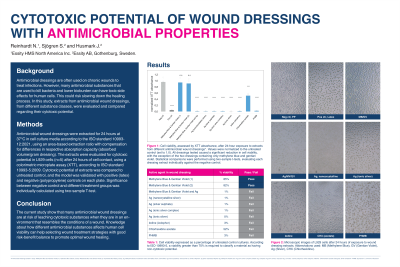
The ISO 10993-5 standard uses a cutoff value of >70% viability compared to untreated cells to claim non-cytotoxic potential. Of the antimicrobial dressings tested, only dressings containing the antimicrobial substances methylene blue and gentian violet passed the test, showing a viability of 82% and 85% respectively compared to untreated control. Wound dressings containing silver (in total 5 dressings) showed a cell viability of between 0-1%. A wound dressing containing iodine and a dressing containing PHMB both showed a cell viability of 3%. A wound dressing containing chlorhexidine reached 52% viability.
Discussion:
The current study show that many antimicrobial wound dressings are at risk of leaching cytotoxic substances when they are in an environment that resembles the conditions of a wound. Knowledge about how different antimicrobial substances affects human cell viability can help selecting wound treatment strategies with good risk-benefit balance to promote optimal wound healing.