
.jpg)
Laboratory Research
Whilst traditional Negative Pressure Wound Therapy (tNPWT) systems have demonstrated efficacy in managing hard-to-heal wounds¹, they are limited by their localized pressure delivery. In contrast, advanced single-use NPWT† systems² have shown accelerated healing outcomes, attributed to their ability to distribute negative pressure across a wider therapeutic zone. To bridge this gap, a novel tNPWT dressing, enhanced with a distribution layer (tNPWT+DL*) and silicone technology has been developed. This dressing can be used with or without a filler and for up to 7-days.
Aim: to evaluate and compare the in vitro performance of the tNPWT+DL* dressing and tNPWT drape‡ focusing on negative pressure delivery to the wound bed and peri-wound regions as well as adherence properties and repositionability.
Methods:
To compare negative pressure delivery, simulated wound model testing was conducted at a set-point of -125 mmHg and flow rate of 42.9 ml/hr using cavity wound model plates and foam filler. Pressure sensors located in the wound cavity and the peri-wound region recorded measurements continuously until canister full. Repositionability was assessed on a wound cavity plate whereby negative pressure was measured following 4 repositioning episodes.
To quantify adhesive properties, peel force testing was performed on the system on a polycarbonate substrate following -120/-125 mmHg therapy for 3 days.
Results:
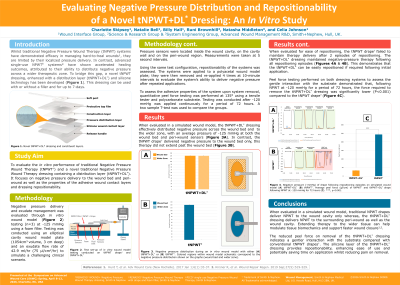
The tNPWT+DL* dressing effectively distributed negative pressure across the wound bed and the peri-wound, tNPWT‡ did not deliver negative pressure beyond the wound bed. After repositioning, the tNPWT drape‡ failed to maintain therapy delivery, whilst the tNPWT+DL* dressing maintained negative-pressure therapy at the wound bed and peri-wound.
Peel force testing demonstrated that, following NPWT, the force required to remove the tNPWT+DL* dressing was significantly lower (P< 0.001) compared to the tNPWT drape‡.
Discussion:
The tNPWT+DL* dressing delivers NPWT beyond the wound to the wider zone. Extending therapy to the wider tissue can help modulate tissue biomechanics and support faster wound closure.
The reduced peel force on removal of the tNPWT+DL* dressing indicates a gentler interaction with the substrate compared with conventional tNPWT drapes. The silicone layer of the tNPWT+DL* dressing provides repositionability, enhancing ease of use and potentially saving time on application whilst reducing pain on removal.