
.jpg)
Chronic wounds are wounds that do not heal within 3 months. These wounds often become stuck in the inflammatory phase of healing due to factors such as infection, poor blood flow, or imbalances in enzymes and signaling molecules. Non-healing wounds significantly affect the patient's quality of life due to their physical and psychological effects.
Methods:
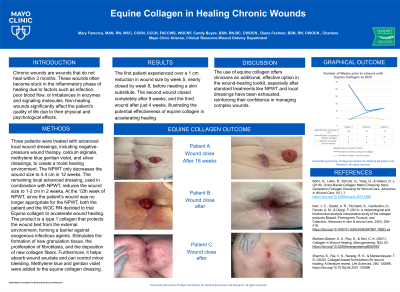
Three patients were treated with advanced local wound dressings, including negative-pressure wound therapy, calcium alginate, methylene blue gentian violet, and silver dressings, to create a moist healing environment. The NPWT only decreases the wound size to 4.4 cm in 12 weeks. The remaining local advanced dressing, used in combination with NPWT, reduces the wound size to 1-2 cm in 2 weeks. At the 12th week of NPWT, since the patient's wound was no longer appropriate for the NPWT, both the patient and the WOC RN decided to trial Equine collagen to accelerate wound healing. The product is a type 1 collagen that protects the wound bed from the external environment, forming a barrier against exogenous infectious agents. Stimulates the formation of new granulation tissue, the proliferation of fibroblasts, and the deposition of new collagen fibers. Furthermore, it helps absorb wound exudate and can control minor bleeding. Methylene blue and gentian violet were added to the equine collagen dressing.
Results:
The first patient experienced over a 1 cm reduction in wound size by week 5, nearly closed by week 8, before needing a skin substitute. The second wound closed completely after 9 weeks, and the third wound after just 4 weeks, illustrating the potential effectiveness of equine collagen in accelerating healing.
Discussion:
The use of equine collagen offers clinicians an additional, effective option in the wound-healing toolkit, especially after standard treatments like NPWT and local dressings have been exhausted, reinforcing their confidence in managing complex wounds.