
.jpg)
Practice Innovations
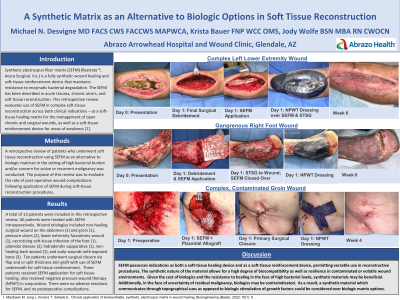
The synthetic electrospun fiber matrix (SEFM) (Restrata ®, Acera Surgical, Inc.) is a fully synthetic wound healing and soft-tissue reinforcement device that maintains resistance to enzymatic bacterial degradation. The SEFM has been described in acute trauma, chronic ulcers, and soft tissue reconstruction.
This retrospective review evaluates use of SEFM in complex soft-tissue reconstruction across both clinical indications – as a soft-tissue healing matrix for the management of open chronic and surgical wounds, as well as a soft-tissue reinforcement device for areas of weakness [1].
Methods:
A retrospective review of patients who underwent soft tissue reconstruction using SEFM as an alternative to biologic matrices in the setting of high bacterial burden and/or concern for active or recurrent malignancy was conducted. The purpose of this review was to evaluate the rate of post-operative wound complications following application of SEFM during soft-tissue reconstruction procedures.
Results:
A total of 13 patients were included in this retrospective review. All patients were treated with SEFM intraoperatively. Wound etiologies included non-healing surgical wound on the abdomen (1) and groin (1), pressure ulcers (2), lower extremity fasciotomy wound (1), necrotizing soft-tissue infection of the foot (1), pilonidal disease (2), hidradenitis suppurativa (1), non-healing back wound (1), and scalp wounds with exposed bone (3). Ten patients underwent surgical closure via flap and or split thickness skin graft with use of SEFM underneath for soft-tissue reinforcement. Three patients received SEFM application for soft-tissue healing, also received negative pressure wound therapy (NPWT) in conjunction.
There were no adverse reactions to SEFM, and no postoperative complications or infections.
Discussion:
SEFM possesses indications as both a soft-tissue healing device and as a soft-tissue reinforcement device, permitting versatile use in reconstructive procedures. The synthetic nature of the material allows for a high degree of biocompatibility as well as resilience in contaminated or volatile wound environments. Given the cost of biologics and the resistance to healing in the face of high bacterial loads, synthetic materials may be beneficial. Additionally, in the face of uncertainty of residual malignancy, biologics may be contraindicated. As a result, a synthetic material which communicates through topographical cues as opposed to biologic stimulation of growth factors could be considered over biologic matrix options.