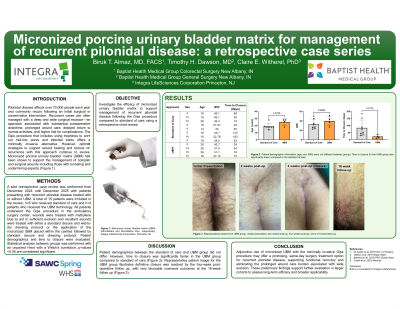
(CS-003) Micronized porcine urinary bladder matrix for management of recurrent pilonidal disease: a retrospective case series
Friday, April 10, 2026
Timothy Dawson, MD; Claire Witherel, PhD
Introduction: Pilonidal disease affects over 70,000 people each year and commonly recurs following an initial surgical or conservative intervention. Recurrent cases are often managed with a deep and wide surgical excision—an approach associated with substantial postoperative downtime, prolonged wound care, delayed return to normal activities, and higher risk for complications. The Gips procedure that includes using trephines to core out mid-line pores and infected tracts offers a minimally invasive alternative. However, optimal strategies to support wound healing and reduce re-recurrence with this approach continue to evolve. Micronized porcine urinary bladder matrix (UBM) has been shown to support the management of complex and surgical wounds including those with tunneling and undermining aspects.
Methods: A retrospective review was performed on three patients presenting with recurrent pilonidal disease after prior index procedures, one patient in particular had experience several recurrences. All patients underwent a Gips procedure in the ambulatory surgery center; wounds were treated with methylene blue to aid sufficient excision and resultant wounds were treated with the application of micronized UBM placed within the cavity, followed by primary closure. Postoperative recovery, time to wound closure, return to daily activities, and recurrence through 12 months of follow-up were evaluated.
Results: All patients tolerated same-day surgery without complications and returned to normal activities the following day. None required home-health nursing or extended time off work for wound care, which is typically necessary following wide excision. Complete wound closure occurred within 4 weeks for all three patients. No recurrences were observed during 12 months of postoperative monitoring.
Discussion: Adjunctive use of micronized UBM with the minimally invasive Gips procedure may offer a promising, same-day surgery treatment option for recurrent pilonidal disease, supporting functional recovery and eliminating the prolonged wound care burden associated with wide excision. These preliminary findings support further evaluation in larger cohorts and comparing against standard of care cohorts to assess long-term efficacy and broader applicability.

.jpg)