
.jpg)
Case Series/Study
Chronic, non-healing surgical wounds present substantial challenges and often require multimodal advanced therapies for resolution. Common options include cellular and acellular matrix products (CAMPs), negative pressure wound therapy (NPWT), and hyperbaric oxygen therapy (HBOT). This case series evaluates the clinical effectiveness of a three-dimensional (3D) porcine-derived wound matrix* in managing post-surgical dehiscence, including a complex case complicated by acute radiation therapy exposure.
Methods:
A retrospective analysis was conducted on two patients with non-healing surgical wounds refractory to standard-of-care (SOC) treatment. Both received applications of the 3D wound matrix within a comprehensive protocol. Data collected included matrix application number and timing, adjunctive therapies (e.g., NPWT and HBOT), prior CAMP usage, comorbidities, wound-related complications, and complete healing outcomes. The objective was to characterize clinical efficacy and healing trajectory in complex surgical wounds.
Results:
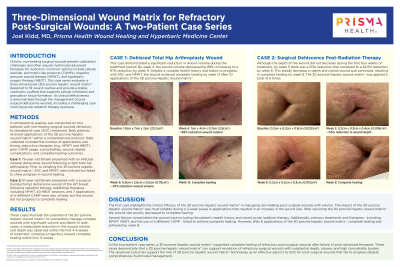
Following 3D wound matrix applications, both wounds achieved complete healing within 8 - 13 weeks. Case 1 (dehisced total hip arthroplasty) initially measured 0.5 × 8 × 3 cm with significant depth, in the setting of bacterial infection, advanced age, and obesity. After NPWT initiation, the patient received 10 sequential 3D matrix applications over 13 weeks, with 89% volume reduction by week 4, 98.5% by week 8, and complete closure by week 13. Case 2 (post-radiation surgical dehiscence) initially measured 1 × 1 × 2.1 cm with a 4.3 cm tunnel at the 10 o’clock position and was complicated by acute radiation therapy, diabetes, tobacco use, active infection, and prior breast cancer. Despite 7 prior applications of an alternative CAMP (DermaCell), 40 HBOT sessions, and NPWT, the wound remained non-healing. After initiation of the 3D matrix (6 applications over 7 weeks), complete healing occurred by week 8.
Discussion:
These cases demonstrate that a 3D porcine-derived wound matrix can support resolution of refractory surgical wounds with substantial depth, tunneling, and high comorbidity burden. The tunneled, radiation-compromised wound in Case 2, which had failed multiple prior advanced therapies, is particularly notable. The observed outcomes support the role of 3D matrix technology as an effective adjunct to SOC for post-surgical wounds that fail to progress despite comprehensive multimodal management.