
.jpg)
Laboratory Research
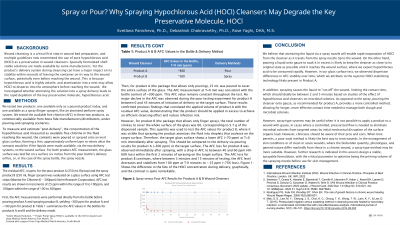
Wound cleansing is critical first step for wound bed preparation, and the specific use of pure hypochlorous acid as a cleanser is now recommended by multiple guidelines. Specially formulated solutions are made available that are shelf-stable over time. Yet, the delivery system of the product during cleansing can have a major impact on the product's stability within seconds of leaving the container. We investigated whether atomizing the solution into a spray delivery leads to the rapid depletion of the key preservative molecule, hypochlorous acid.
Methods:
We tested two products: one available only in a pour version, and one available in a spray version (as well as a pourable version). We tested the available free chlorine (AFC) in these two products, as available commercially from bona fide distributors, in the "bottles" or "post-delivery" in the soaking or spraying scenarios. To measure the ppm values "in the bottles", the contents were gently removed from the bottles (50 ml) into a petri dish. To measure "post-delivery", the contents were poured/sprayed onto an inert glass surface, forming a thin, approximately uniform layer. For spraying/pouring, the glass surface was laid flat on a surface six inches from the pour bottle’s delivery orifice, or, in the case of the spray bottle, the spray nozzle.
Results:
Product A (Pour bottles only) showed a higher original ppm value than either the pour or the spray bottles of Product B. Post pouring, on an inert glass surface, both product A and B (the pour bottle variant) retained the ppm AFC value within 10% of the value of “in the bottle”. Post-spraying, Product B on the sprayed surface surprisingly showed a loss of approximately 90% of its original value as measured “in the bottle.”
Discussion:
We believe that atomizing the liquid via a spray nozzle will enable rapid evaporation of HOCl from the cleanser as it travels from the spray nozzle tip to the wound. On the other hand, pouring a liquid onto gauze for soaking is likely to keep the cleanser as close to its original state as possible. Therefore, spraying causes the liquid to "run off" the wound, limiting the contact time, which should ideally be between 2 and 5 minutes. In contrast, pouring the cleanser onto gauze for soaking provides a more controlled method, allowing for longer and more effective contact time needed for managing slough and microbial colonies.