(CR-057) Interim analysis of lyophilized human amnion/chorion mem-brane for the management of chronic diabetic foot ulcers in the CAMPAIGN trial
Friday, April 10, 2026
Brianna Tramelli, BS – SerenaGroup, Inc.; Zwelithini Tunyiswa, BA – Open Wound Research; Brittany Bonafide, BS – SerenaGroup, Inc.
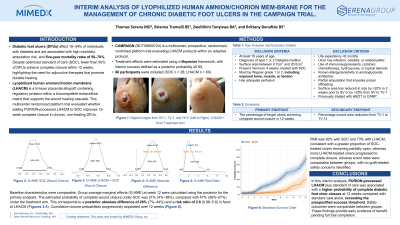
Introduction: Diabetic foot ulcers (DFUs) remain a clinical challenge due to their prolonged healing times and association with substantial morbidity, mortality, and financial burden. Conventional standard-of-care (SOC) management often fails to achieve satisfactory closure rates, indicating a need for treatment options capable of improving patient outcomes and reducing healthcare costs.
Methods: This interim assessment of a multicenter, prospective, randomized, controlled platform trial investigating whether multiple lyophilized human amnion/chorion membrane (LHACM1) products used in conjunction with SOC improve healing outcomes compared with SOC alone. The primary endpoint was the percentage of target ulcers achieving complete closure in 12 weeks. Ulcers were considered closed when 100% re-epithelialization was achieved without drainage for two consecutive weeks. A Bayesian analysis was applied to estimate treatment effects and quantify uncertainty.
Results: Interim Bayesian modeling demonstrated that LHACM-treated participants had a meaningful advantage over SOC alone. The probability of achieving full healing under SOC was estimated at 23% (6.5% to 42%), whereas the LHACM arm showed a posterior healing probability of 47% (37% to 59%). The resulting absolute difference of 24% (4% to 43%) and risk ratio of 2.6 (0.8 to 5.0) both favored LHACM. Overall, the Bayesian posterior probability that LHACM improved wound closure compared with SOC was 98.5%, indicating a high likelihood of clinical benefit at this stage of analysis.
Discussion: This interim evaluation suggests that LHACM-based therapy may substantially enhance healing rates in DFUs relative to SOC. The Bayesian framework supports a strong probability that LHACM improves the odds of wound closure and may shorten the healing trajectory. These preliminary findings warrant confirmation as additional participants complete follow-up and final results become available (New analysis on >100 patients will be run for the SAWC Spring conference. Results to be determined).

.jpg)