
.jpg)
Laboratory Research
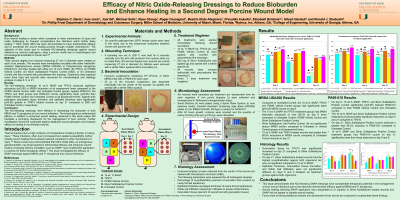
Burn wound healing is slower when compared to other mechanisms of injury and made challenging by frequent complications like infections which further delay healing.1-3 Nitric Oxide (NO) has been demonstrated to have antimicrobial efficacy and to accelerate the wound healing process through multiple mechanisms.4 The objective of this study was to evaluate NO-releasing dressings against wound infections by common pathogens, using a porcine model due to morphological and immunological similarities to human skin.5,6
Methods: Thirty second degree burn wounds measuring 27 mm in diameter were created on each of six animals. The wounds were immediately inoculated with either methicillin-resistant Staphylococcus aureus (MRSA USA300) or Pseudomonas aeruginosa (PA09-010)7 and then treated with either (A) 10 wt.% SNAP, (B) TPS10, (C) PDMS Vehicle Control, (D) Silver Sulfadiazine Positive Control (SSD), or (E) Untreated Control and then covered with polyurethane film dressing. Treatments were replaced every three days and wounds were recovered for microbiological and histology analysis on days 6, 9, or 21.
Results: The NO-releasing dressings 10 wt.% SNAP and TPS10 produced significant reductions (p≤0.05) in MRSA bioburden at all assessment times compared to the PDMS Vehicle Control, SSD, and Untreated Control groups. Against PA09-010, the TPS10 and SSD groups had PA09-010 counts significantly lower (p≤0.05) than PDMS Vehicle Control and Untreated Control at all assessment times. Against both pathogens granulation tissue formation and epithelial thickness were significantly (p≤0.05) greater in TPS10 treated wounds on day 21 compared to SSD and Untreated Control, respectively.
Discussion: The NO-releasing dressings were effective in decreasing the bioburden of both MRSA and P. aeruginosa in burn wound infections. The broad-spectrum antimicrobial efficacy, coupled with enhanced wound healing observed in this study, makes NO therapies a promising therapeutic approach for the management of burn wounds. Further investigation should assess efficacy against additional wound pathogens and evaluate the effects on healing in non-infected wounds.