
.jpg)
Case Series/Study
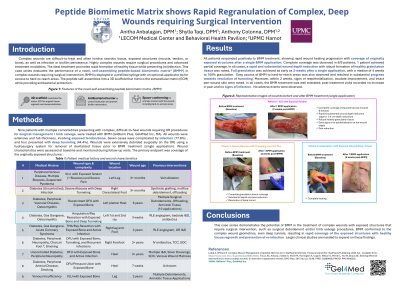
Complex wounds are characterized by delayed healing and often involve necrotic tissue, exposed structures, and infection/biofilm persistence. Highly complex wounds demand surgical management and advanced treatment modalities. The ideal treatment promotes rapid formation of healthy tissue while preventing (re)infection. This prospective case series evaluates the performance of a novel, self-assembling peptide-based biomimetic matrix (BMM) in complex wounds requiring surgical intervention. BMM is deployed in a prefilled syringe with an applicator tip for access to hard-to-reach areas. The peptide self-assembles into a 3D scaffold that mimics the endogenous extracellular matrix while providing antibacterial protection.
Methods:
Nine patients with multiple comorbidities presenting with complex, difficult-to-treat wounds - including diabetic foot ulcers, venous leg ulcers, and amputation wounds - requiring operating room procedures for surgical management / limb salvage, were selected to receive BMM. All wounds were extensive and full-thickness, involving exposed tendon (1/9) or bone (8/9). Six cases were complicated by infection, and three presented with deep tunneling. Wounds were extensively debrided surgically using a hydrosurgery system for removal of devitalized tissue prior to BMM application. Wound characteristics were assessed at baseline and during follow-up visits. The primary endpoint was coverage of the originally exposed structures.
Results:
Despite the severity and complexity of the wounds, all patients responded positively to BMM, showing rapid wound healing progression with complete (8/9) or partial (1/9) coverage of the originally exposed structures. In all cases, a substantial reduction in wound depth was observed with formation of healthy granulation tissue (full granulation as early as 2-weeks after a single application). Easy access to hard-to-reach areas was also noted, resulting in resolution of tunneling as early as one-week post-treatment. Moreover, within 2 weeks, signs of reepithelialization, exudate improvement, and intact peri-wound skin were observed. In all cases, the post-BMM treatment visits recorded no signs of (re)infection and no product-related adverse events.
Discussion:
This case series demonstrates the potential of BMM in the surgical management of complex wounds with exposed structures. BMM conformed to the wounds, including deep tunnels, achieving rapid tissue regrowth over the exposed structures and preventing re-infection. Larger clinical studies are needed to expand on these findings.