(LR-019) In vitro evaluation of cytotoxic and proliferative effects of wound irrigation solutions on human skin cells
Saturday, April 11, 2026
4:00 PM - 5:00 PM ET
Malin Bjursten Brailsford, PhD – Mölnlycke Health Care; Tina Hamberg, PhD – Mölnlycke Health Care; Anette Svensson Henriksson, PhD – Mölnlycke Health Care
Introduction: To evaluate the effect of six wound irrigation solutions on tissue viability by assessing the cytotoxic and proliferative effects on normal human epidermal keratinocytes (NHEK) and normal human dermal fibroblasts (NHDF).
Methods: NHEK and NHDF cell cultures in low or serum-free growth medium were exposed to wound irrigation solutions for 15 minutes, simulating a clinically relevant worst-case scenario. The exposure was dose-dependent, ranging from undiluted (100%) down to 50% dilution. Cell viability was assessed with Cell Counting Kit-8 (CCK-8) assay immediately after 15-minutes exposure, while cell proliferation was measured with CyQUANT cell proliferation assay, 24 hours post-treatment to allow for cell division to occur.
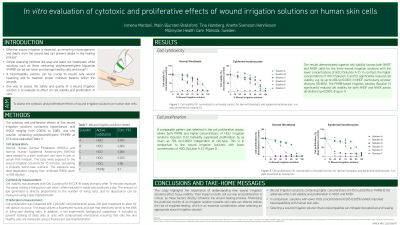
Results: In this study, the cytotoxic and proliferative effects of six wound irrigation solutions containing hypochlorous acid (HOCl) in concentrations ranging from 0.003% to 0.08%, and polyhexamethylene biguanide (PHMB) at 0.1% were evaluated. The results demonstrated superior cell viability (across both NHEK and NHDF cells) for the two wound irrigation solutions with the lower concentrations of HOCl (0.003% and 0.004%). Higher concentrations of HOCl (0.033% and 0.08%) significantly reduced cell viability with as much as 60% (p< 0.0001), particularly at lower dilutions. The PHMB-based irrigation solution significantly reduced cell viability for both NHEK and NHDF across all dilutions (p< 0.0001). A similar trend was observed in cell proliferation assays, where both PHMB and higher concentrations of HOCl irrigation solutions impaired cell proliferation with as much as 70% (p< 0.0001) regardless of cell-type.
Discussion: Wound irrigation solutions containing higher concentrations of HOCl (≥0.033%) or PHMB (0.1%) adversely affected cell viability and proliferation in NHEK and NHDF. In comparison, solutions with lower HOCl concentrations (0.003-0.004%) exhibited improved biocompatibility with human skin cells.

.jpg)