
.jpg)
Case Series/Study
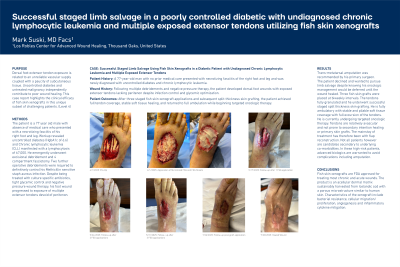
The patient is a 77 year old male with absence of medical care who presented with a necrotizing fasciitis of his right foot and leg. Workup revealed uncontrolled diabetes (HgbA1c of 6.6) and Chronic lymphocytic leukemia (CLL) manifested with a lymphocytosis of 67,000. He emergently underwent excisional debridement and 4 compartment fasciotomy. Two further operative debridements were required to definitively control his Methicillin sensitive staph aureus infection. Despite being treated with culture specific antibiotics, tight glycemic control and negative pressure wound therapy, his foot wound progressed to exposure of multiple extensor tendons devoid of peritenon.
Results:
Trans-metatarsal amputation was recommended by his primary surgeon. The patient declined and wanted to pursue limb salvage despite knowing his oncologic management would be deferred until the wound healed.
Three fish skin grafts were placed at biweekly intervals. The tendons fully granulated and he underwent successful staged split thickness skin grafting. He is fully ambulatory with stable and pliable soft tissue coverage with full excursion of the tendons. He is currently undergoing targeted oncologic therapy.
Discussion:
Tendons are relatively avascular and not prone to secondary intention healing or primary skin grafts. The mainstay of treatment has therefore been with flap reconstruction. Not all patients however are candidates secondary to underlying co-morbidities. In these high-risk patients, advanced biologics are warranted to avoid complications including amputation.
Fish skin xenografts are FDA approved for treating most chronic and acute wounds. The product is an acellular dermal matrix sustainably harvested from Icelandic cod with a porous microstructure similar to human skin. Characteristics of the xenograft include bacterial resistance, cellular migration/proliferation, angiogenesis and inflammatory cytokine mitigation.